Nex Gen Retail Summit

Categories
Banking

AI-Powered Personalization: Turning Shopper Data into Meaningful Experiences

AI-Powered Personalization: Turning Shopper Data into Meaningful Experiences

Today’s shoppers expect more than discounts and product variety. They expect brands to understand them. AI-powered personalization helps retailers turn shopper data into experiences that feel relevant, timely, and genuinely useful.

From tailored product recommendations to personalized messaging across channels, AI is redefining how retailers engage customers and build loyalty.

Why Personalization Matters

Consumers are more willing to engage with brands that recognize their preferences and past behaviour. Studies show that shoppers are more likely to buy from brands that offer relevant recommendations and personalized experiences, especially when these interactions feel helpful rather than intrusive.

For retailers, the impact is tangible. AI-driven personalization improves conversion rates, increases repeat purchases, and strengthens long-term customer relationships. It allows brands to move away from one-size-fits-all marketing and towards meaningful, individual connections.

How AI Turns Data into Experiences

AI works behind the scenes by analyzing vast amounts of shopper data and identifying patterns that humans cannot process at scale. This includes browsing history, purchase behaviour, channel interactions, and contextual signals such as time, location, and device.

Instead of reacting after the fact, AI enables retailers to predict intent and respond in real time.

From Data to Experience: The Personalization Flow

This is how AI-powered personalization typically works in retail:

  1. Shopper Data Collection
    Website behaviour, app activity, purchase history, loyalty data, and in-store interactions are captured across touchpoints.
  2. AI Analysis & Learning
    Machine learning models analyze patterns, preferences, and intent using both historical and real-time data.
  3. Insight Generation
    AI predicts what a shopper is likely to want next, when they are most likely to engage, and which channel works best.
  4. Personalized Experience Delivery
    Tailored product recommendations, customized content, targeted offers, and relevant messaging are delivered across digital and physical channels.

Continuous Optimization
Each interaction feeds back into the system, helping AI refine future recommendations and improve accuracy over time.
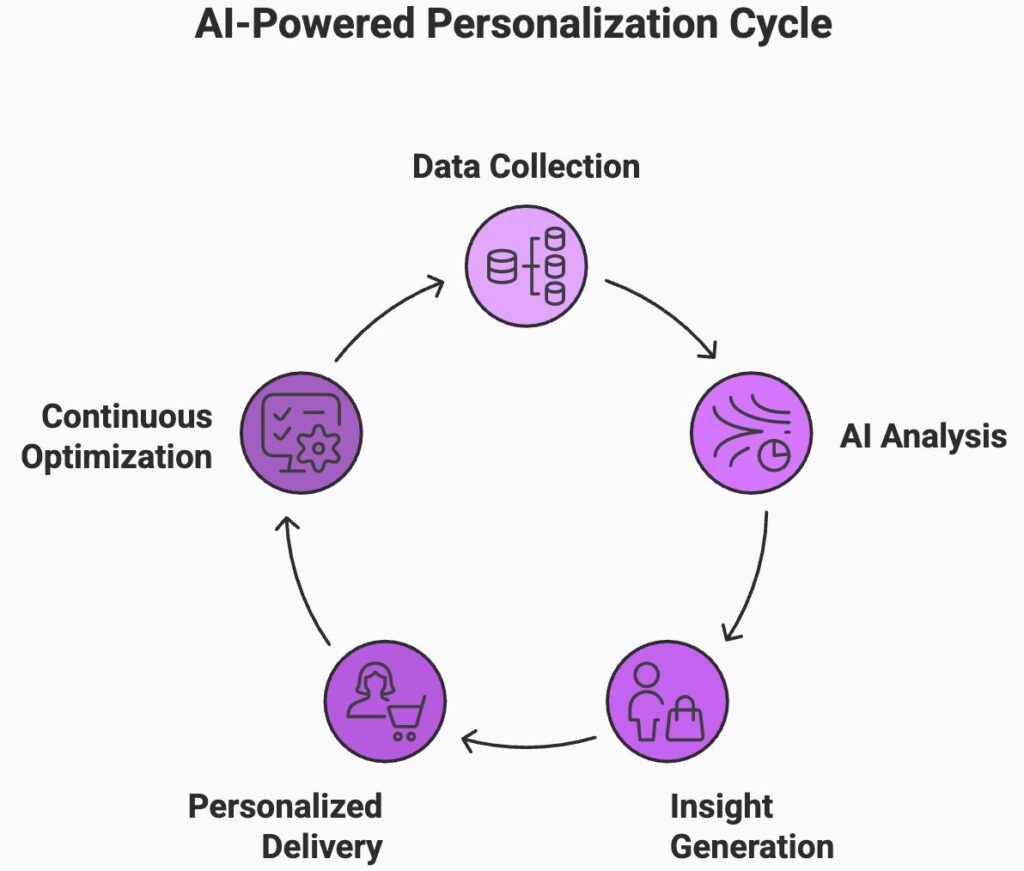
This closed-loop system allows personalization to evolve with the customer rather than remain static.

Making Personalization Feel Human

The success of AI personalization depends on trust. Shoppers want relevance, but they also want transparency and control. Retailers that clearly communicate how data is used and give customers choice over their preferences are more likely to earn long-term loyalty.

When done right, AI personalization feels less like marketing and more like good service.

What This Means for Retail Leaders

AI-powered personalization is no longer experimental. It is becoming a core capability for retailers looking to stay competitive in an experience-driven market. The focus is shifting from collecting data to using it intelligently and responsibly to create value for both customers and businesses.

At TechTrek Events, we organize forums and discussions that bring together industry professionals to explore the latest trends and innovations.

The NexGen Retail Summit provides a platform for these conversations, where leaders and innovators share insights and ideas on how AI and emerging technologies are driving the next wave of growth in retail.


Categories
Banking

Sustainable Retail in the Age of AI

Sustainable Retail in the Age of AI

In an era where environmental, social, and governance performance increasingly shapes corporate strategy, the retail industry faces mounting pressure to innovate responsibly. From climate commitments to ethical supply chains and transparent reporting, retailers must deliver measurable sustainability outcomes. One of the most powerful enablers of this transformation? Artificial Intelligence.

AI is no longer a futuristic concept, today it’s a practical tool that empowers retailers to achieve smarter, faster, and more impactful sustainability decisions, helping them reduce waste, optimize resource use, strengthen governance, and enhance stakeholder trust.

Why AI Matters for ESG in Retail

At its core, ESG in retail involves tracking and improving environmental impact (like carbon emissions and resource use), social performance (such as supply chain labor standards), and governance quality (including compliance and transparency). Traditionally, many retailers have struggled with fragmented data, labor-intensive reporting, and manual processes that slow sustainability progress.

AI addresses these barriers by automating data collection, enhancing data accuracy, and producing real-time insights, enabling decision-makers to act swiftly on sustainability priorities, from store operations to global supply chains.

1. Turning Data into Actionable Insights

One of the most significant contributions of AI to ESG is its ability to process vast, complex datasets quickly and accurately.

Modern AI systems can ingest sustainability data from multiple sources, energy sensors, logistics platforms, supplier disclosures, and even unstructured reports, and convert it into actionable insights. This capability makes real-time tracking of emissions and resource consumption possible, giving retailers a dynamic view of their ESG performance rather than lagging annual reports.

Beyond simple reporting, AI algorithms also forecast trends and model future scenarios. This allows companies to anticipate emissions hotspots or supply chain risks before they materialize, enabling proactive planning and reduction strategies.

2. Optimizing Supply Chains for Sustainability

Supply chain operations represent one of the biggest ESG levers for retailers. AI plays a crucial role in:

  • Demand forecasting and inventory optimization, reducing overstocking and waste;
  • Supplier sustainability assessment, where AI can evaluate partner practices and flag potential ESG risks;
  • Route optimization in logistics, lowering fuel use and emissions by planning energy-efficient delivery routes.

These functions not only reduce environmental impact but also drive cost efficiencies – demonstrating that sustainability and profitability can go hand in hand.

3. Energy and Waste Management

Energy consumption is a key environmental metric for retail operations. AI-driven tools can optimize energy use across stores, distribution centers, and offices by dynamically adjusting lighting, HVAC systems, and other utilities based on real-time conditions. This leads to significant reductions in both emissions and operating costs.

In addition, advanced machine learning models improve inventory accuracy and waste reduction. By predicting demand more precisely, retailers minimize excess stock that would otherwise lead to markdowns, disposals, or overproduction – practices that cumulatively contribute to carbon emissions and waste streams.

4. Enhancing Traceability and Transparency

For ESG objectives to be credible, transparency is essential. Consumers and investors increasingly demand visibility into product origins, labor standards, and environmental impact throughout the value chain.

AI plays an important role in traceability systems, helping retailers track products from source to store and ensuring compliance with evolving sustainability standards. This improves trust and strengthens brand reputation while helping retailers adhere to regulatory requirements.

5. Improving ESG Reporting and Compliance

ESG reporting is complex – not just because of the volume of data, but also due to regulatory scrutiny and stakeholder expectations. AI simplifies this task by automating data aggregation and analysis, reducing manual effort and error, and enabling accurate, timely disclosure of ESG metrics.

Automated systems also help monitor evolving standards and integrate multiple sustainability frameworks, ensuring retailers can adapt quickly and maintain compliance in a changing regulatory landscape.

6. Aligning ESG with Strategic Decision-Making

True sustainability leadership goes beyond compliance – it’s about embedding ESG into business strategy.

AI helps retailers make ESG considerations central to everyday decisions: choosing energy-efficient technologies, selecting sustainable suppliers, setting product pricing that reduces waste, and tailoring offerings to environmentally conscious customer segments. This positions sustainability not as an add-on, but as a core driver of competitive advantage and long-term growth.

The Future of Retail Sustainability with AI

The market for AI in ESG and sustainability is expanding rapidly. Analysts project that AI solutions for ESG will experience strong growth in the coming years, driven by increasing regulatory demands, stakeholder expectations, and the need for efficient data-driven decision-making.

As AI technologies evolve, such as advanced predictive modeling, natural language processing, and automated scenario planning, the breadth and depth of their sustainability impact will continue to grow.

Smart Decisions for a Sustainable Tomorrow

Sustainability is no longer a peripheral concern, it’s a strategic imperative. In the retail sector, AI offers a powerful toolkit for transforming ESG commitments into measurable outcomes. By improving data quality, strengthening supply chain transparency, optimizing energy use, and enabling real-time ESG insights, AI empowers retailers to make smarter, more impactful decisions.

At TechTrek Events, we organize forums and discussions that bring together industry professionals to explore the latest trends and innovations. 

The NexGen Retail Summit provides a platform for these conversations, where leaders and innovators share insights and ideas on how AI and emerging technologies are driving the next wave of growth in retail.
Categories
Banking

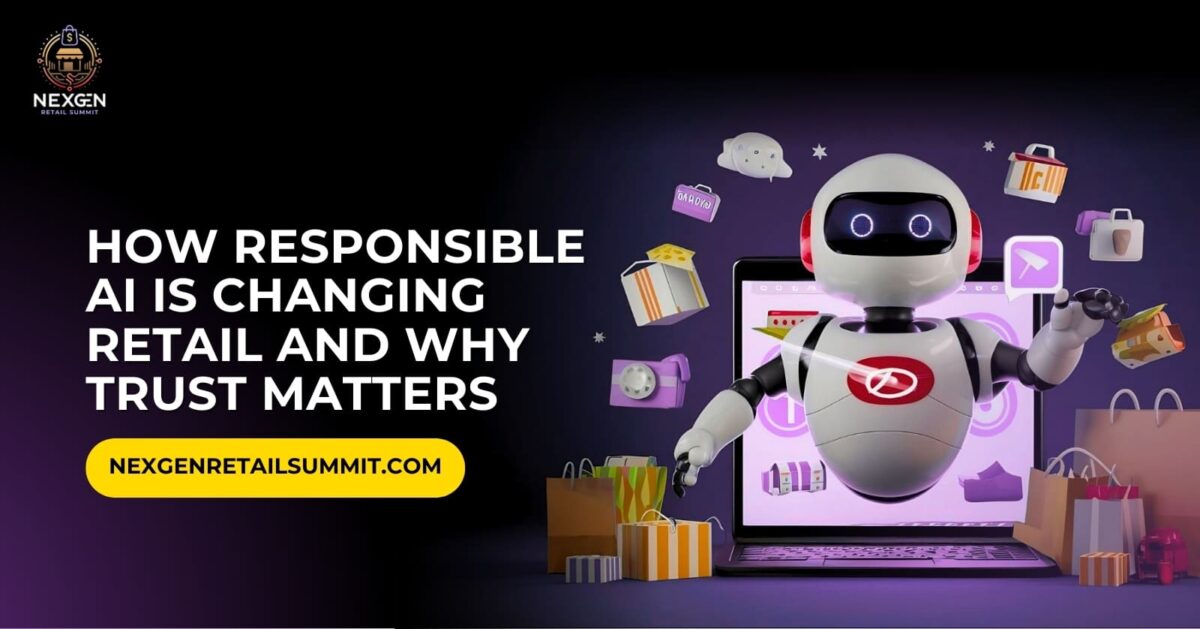
How Responsible AI Is Changing Retail and Why Trust Matters

How Responsible AI Is Changing Retail and Why Trust Matters

Artificial intelligence is now a core part of retail. It powers product recommendations, demand forecasting, chatbots and pricing decisions. These tools make shopping faster and more personalized. But they also raise important questions. Customers want to know how their data is used and whether AI decisions are fair.

This is why Responsible AI matters.

What Is Responsible AI?

Responsible AI means designing and using artificial intelligence in a way that is ethical, transparent and accountable. It ensures that technology benefits both businesses and customers without compromising privacy or fairness. 

For retailers, Responsible AI focuses on four main areas:

  • Clear and honest use of customer data
  • Fair and unbiased decision making
  • Strong privacy protection
  • Human oversight and accountability

When these principles guide AI systems, customers feel safer and more confident.

Why Retailers Must Care

Retail runs on customer data. Every online search, purchase and loyalty card swipe creates information that AI can analyze. While this helps create better experiences, it can also create mistrust if handled poorly.

Shoppers today are more aware than ever about digital privacy. If they feel their data is misused or decisions are unclear, they quickly lose trust in a brand. Responsible AI helps retailers avoid this risk by being open and ethical from the start.

How Responsible AI Builds Trust

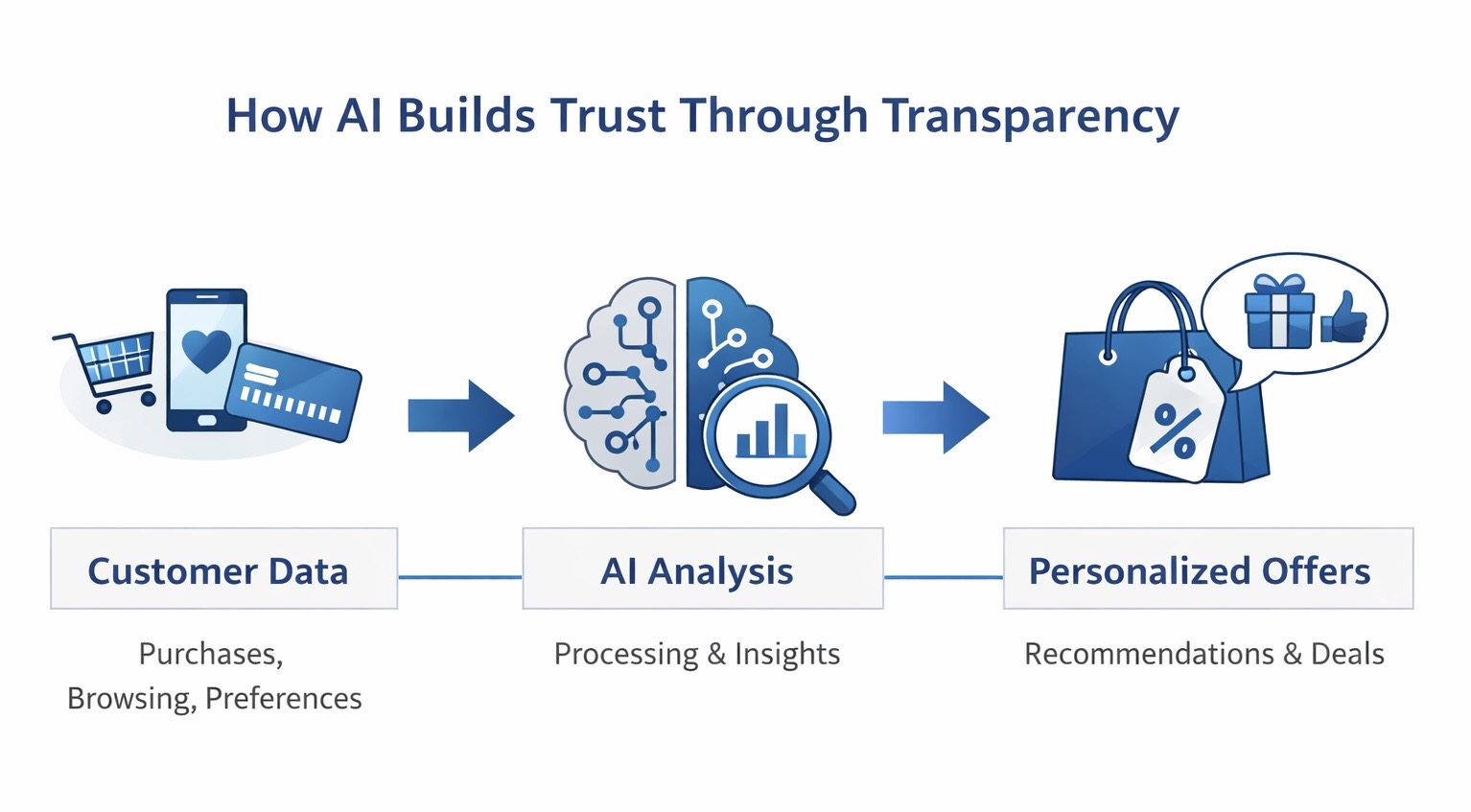
1. Transparency

Customers should understand why they see certain offers or recommendations. Simple explanations about how AI works reduce confusion and build confidence.

2.Fairness

AI models can unintentionally reflect bias from old data. Retailers need regular checks to ensure systems treat all customer groups equally. Fair AI leads to better and more inclusive customer experiences.

3.Privacy Protection

Personalization should never come at the cost of privacy. Responsible retailers clearly ask for consent, protect sensitive information and limit how long data is stored. Respecting privacy is the fastest way to earn loyalty.

4.Governance

AI decisions must have human accountability. Internal guidelines, audits and review teams ensure that technology remains aligned with company values and legal requirements. 

5.Compliance Is Now Essential

Governments worldwide are introducing stricter rules on AI and data usage. Retailers must follow these regulations to avoid legal and reputational problems. Responsible AI helps businesses stay compliant while still innovating.

The Bottom Line

AI offers huge opportunities for retail, but only if customers trust it. Responsible AI allows retailers to balance innovation with ethics. It creates better experiences, stronger relationships and safer use of technology.

The brands that succeed in the future will not just be the smartest. They will be the most responsible.

At TechTrek Events, we bring together industry leaders to explore how emerging technologies are transforming marketing, retail, and commerce.

The NexGen Retail Summit provides a platform for these conversations, where brands, retailers, and innovators share insights on how AI-powered content and campaigns are shaping the future of growth.

Categories
Banking

GenAI for Marketers: Transforming Product Content, Visuals & Campaign Creation

GenAI for Marketers: Transforming Product Content, Visuals & Campaign Creation

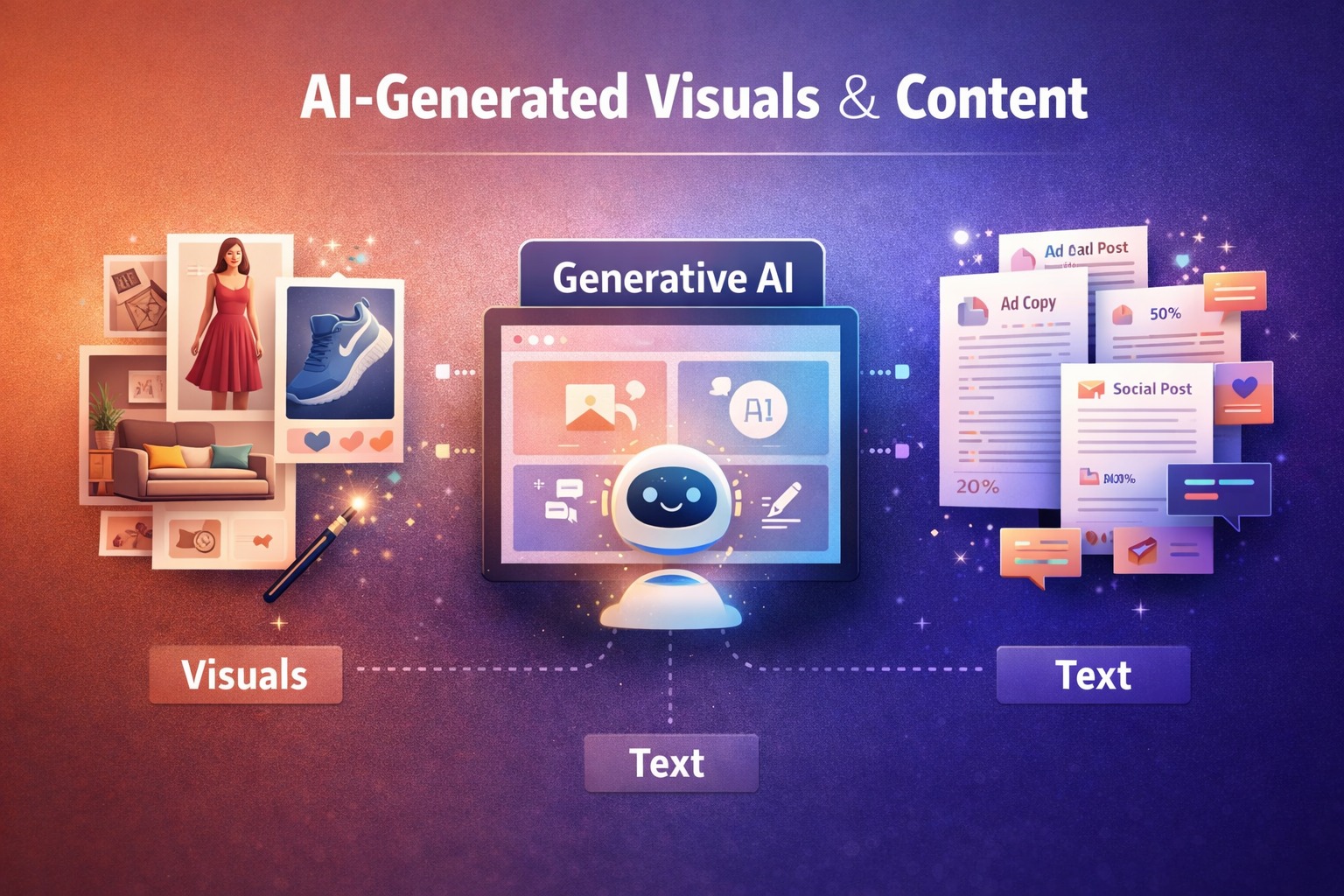
Generative AI (GenAI) is reshaping how marketers create, scale, and personalise content across retail and e-commerce. By generating text, visuals, and campaign assets at speed, GenAI enables brands to move beyond manual production toward intelligent, adaptive marketing experiences.

Rather than replacing human creativity, GenAI enhances it allowing marketers to focus on strategy, storytelling, and performance. This evolution is changing how products are presented, how.

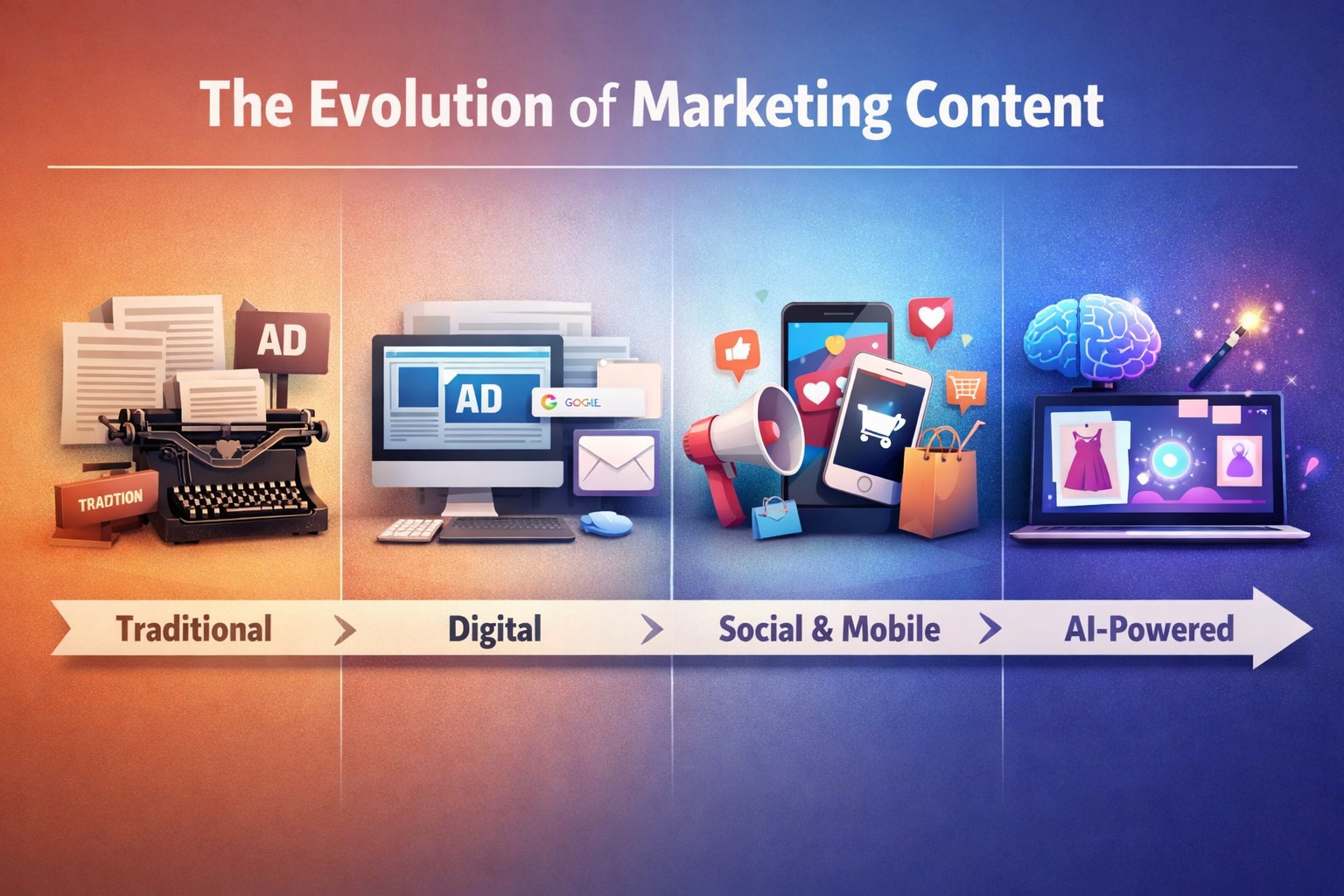
The Evolution of Marketing Content

Marketing has continuously evolved from print advertising and mass media to digital, social, and performance-driven channels. As customer expectations for relevance and speed have grown, content creation has become more complex and resource-intensive.

Today, GenAI represents the next major shift. Instead of starting from static templates or long production cycles, marketers can generate content dynamically based on brand guidelines, audience data, and real-time insights. This transition from manual execution to AI-assisted creativity is redefining modern marketing workflows and will be a key focus at the NexGen Retail Summit 2026, where leaders explore the future of experience-led growth.

What Makes GenAI Different

GenAI differs from traditional automation by generating original content rather than optimising existing assets. It understands language, imagery, and brand context to produce text, visuals, and ideas that feel human and relevant.

For example, marketers can generate product descriptions, social captions, ad copy, and campaign visuals from a single prompt adapting tone, format, and messaging for different audiences. GenAI shifts marketing from production-heavy workflows to insight-driven creativity, allowing teams to test, learn, and optimise faster.

Where GenAI Is Making an Impact

Product Content Creation
GenAI enables scalable creation of product titles, descriptions, and feature highlights across large catalogues. Retailers use it to improve consistency, localisation, and speed to market.

AI-Generated Visuals
From lifestyle imagery to campaign creatives, GenAI supports rapid visual generation without traditional photoshoots. This allows brands to experiment, localise, and personalise visuals efficiently.

Campaign Ideation & Copy
Marketers use GenAI to generate headlines, taglines, and creative variations, accelerating campaign development and enabling continuous optimisation.

Personalised Experiences
When combined with customer data, GenAI supports tailored messaging across emails, ads, and landing pages, aligning content with individual preferences and behaviours.

Together, these use cases highlight how GenAI is shifting marketing from transactional content creation to experience-driven engagement.

Enablers and Ethical Considerations

To scale GenAI effectively, marketers must invest in:

• Clean product and customer data.
• Clear brand voice and creative guardrails.
• Integrated martech and commerce platforms.
• Responsible AI frameworks for accuracy, bias, and IP protection.

Without governance and trust, GenAI risks inconsistency or misuse. Marketers must ensure AI enhances creativity while maintaining transparency and customer confidence.

Preparing for the GenAI Future

Marketers can begin by:

• Identifying high-effort, repeatable content workflows
• Piloting GenAI for product content or campaign ideation
• Training teams to collaborate with AI tools
• Establishing ethical and brand governance early
• Measuring success through relevance, engagement, and performance

GenAI represents a defining shift in marketing one where creativity scales intelligently and content adapts to customer needs in real time. By embracing GenAI thoughtfully, marketers can deliver faster, more relevant, and more impactful experiences.

At TechTrek Events, we bring together industry leaders to explore how emerging technologies are transforming marketing, retail, and commerce.

The NexGen Retail Summit provides a platform for these conversations, where brands, retailers, and innovators share insights on how AI-powered content and campaigns are shaping the future of growth.

Categories
Banking

Multimodal AI: How Visual Search, AR & Voice Are Merging the Shopping Experience

Multimodal AI: How Visual Search, AR & Voice Are Merging the Shopping Experience

Multimodal AI in retail is transforming how consumers discover, evaluate, and purchase products by blending vision, speech, and interaction into a seamless, intuitive journey.

The Evolution of Retail Interaction

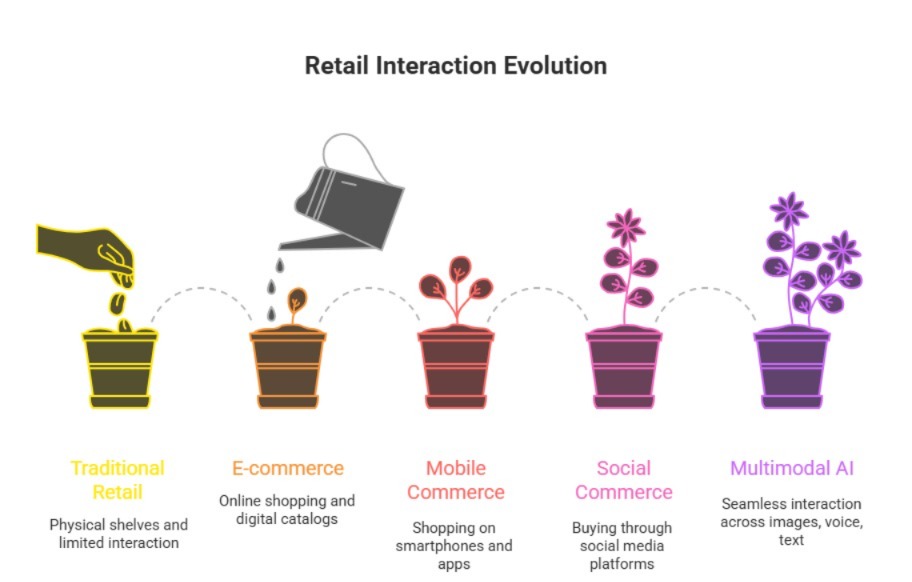
Retail has continuously adapted to how people shop from physical shelves to e-commerce, mobile apps, and social commerce. Today, another major shift is underway: multimodal AI, where systems understand and respond across images, voice, text, and spatial environments.

Rather than relying on clicks or keywords alone, shoppers can now speak, scan, and see their way through the buying journey. This convergence of visual search, augmented reality (AR), and voice AI is redefining how brands connect with consumers and will be a central theme at the NexGen Retail Summit 2026, where leaders explore the future of experience-led commerce.

Where Digital Shopping Stands Today

Modern retail already uses AI-powered recommendations, chatbots, and personalization engines. Visual discovery through social platforms, voice assistants for reordering, and AR try-ons are increasingly common.

According to Google, more than 50% of shoppers now say visual information is more important than text when making purchase decisions. Yet many retail experiences remain fragmented voice, visual, and in-store journeys often operate in silos. The next step is integration, where AI understands context across multiple inputs simultaneously.

What Makes Multimodal AI Different

Multimodal AI in retail enables systems to process multiple types of data at once combining what a shopper sees, says, and does to deliver richer, more human-like interactions.

For example, a customer can photograph a product, ask a voice assistant for alternatives, and instantly view an AR overlay showing fit, size, or placement all within a single journey. As defined by leading AI researchers, multimodal systems move beyond single-input intelligence to contextual understanding that mirrors real-world decision-making.

Microsoft and Meta highlight multimodal AI as foundational to immersive commerce, enabling retail environments that respond dynamically to shopper intent rather than static commands.

Where Multimodal AI Is Already Making an Impact

Visual Search & Discovery
Shoppers can search by image rather than keywords, discovering products through photos, screenshots, or social content. Retailers report higher conversion rates as visual search removes friction from product discovery.

Augmented Reality Try-Ons
AR enables customers to visualize products from makeup and eyewear to furniture and fashion in real-world environments. This reduces returns, boosts confidence, and bridges the gap between online and physical retail.

Voice-Enabled Commerce
Voice assistants allow shoppers to search, compare, and reorder products hands-free. When combined with visual interfaces, voice becomes a powerful layer that simplifies navigation and decision-making.

In-Store Immersive Experiences
Multimodal AI powers smart mirrors, interactive displays, and AI-assisted sales tools that adapt in real time to customer behavior, foot traffic, and preferences.

Together, these use cases demonstrate how AI-powered retail innovation is shifting from transactional shopping to experiential engagement.

Enablers and Ethical Considerations

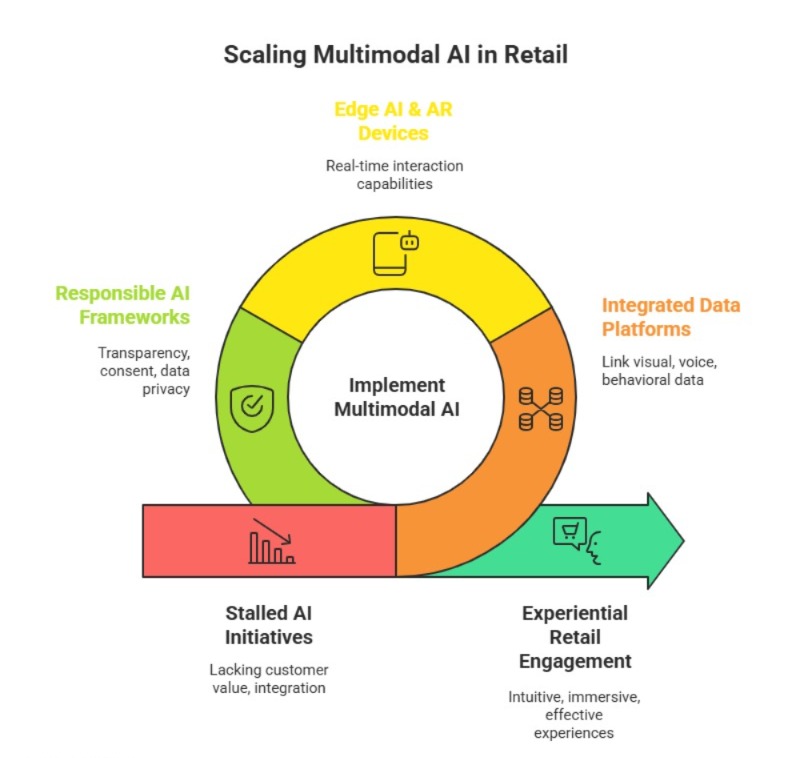
To scale multimodal AI effectively, retailers must invest in:

  • Integrated data platforms linking visual, voice, and behavioral insights
  • Edge AI and AR-capable devices for real-time interaction
  • Responsible AI frameworks to ensure transparency, consent, and data privacy

However, challenges remain. Gartner notes that immersive AI initiatives can stall without clear customer value and cross-channel integration. Retailers must balance innovation with trust, ensuring AI enhances rather than overwhelms the shopping experience.

Preparing for the Multimodal Future

Retailers can begin their multimodal AI journey by:

  • Auditing customer touchpoints to identify friction
  • Piloting visual search or AR in high-impact categories
  • Training teams to design AI-driven experiences, not just tools
  • Ensuring ethical data usage and clear customer opt-in
  • Partnering with technology ecosystems to scale safely

Multimodal AI represents a defining shift in retail one where seeing, speaking, and experiencing converge into a single, intelligent journey. By meeting customers in the way they naturally interact with the world, retailers can create experiences that are more intuitive, immersive, and effective.

At TechTrek Events, we bring together industry leaders to explore how emerging technologies are reshaping commerce.

The NexGen Retail Summit provides a platform for these conversations, where retailers, brands, and innovators share insights on how AI-driven experiences are powering the next wave of retail growth.

Categories
Banking

AI + Cloud + IoT: The Tech Trinity Powering Smart Retail in 2026

AI + Cloud + IoT: The Tech Trinity Powering Smart Retail in 2026

The retail industry has seen waves of innovation over the years, but none as profound as the shift happening today. As we head into 2026, three technologiesAI, cloud computing and IoTare coming together in a way that is rewriting the rules of retail. What once felt like distant “future tech” is now quietly running inside stores, warehouses and even the apps customers use every day.

Walk into any modern retail environment and you can feel the difference. Decisions are faster. Shelves are better stocked. Customer journeys feel smoother, more personalised, more intuitive. Under the surface, it is the tech trinity powering the whole experience.

This accelerationand what it means for global brandswill be a major theme at the NexGen Retail & E-Commerce Summit 2026 in London, where leaders will discuss how these technologies are shaping the next decade of retail.

A New Era of Connected Retail

For years, retailers tried to make sense of data scattered across stores, websites, supply chains and CRM platforms. The systems didn’t talk to each other, and teams often worked in silos. Today, that model simply doesn’t work.

Retailers are now building fully connected ecosystems, where cloud platforms collect data from every corner of the organisation. IoT sensors track product movement, monitor shelves and offer real-time visibility into store and warehouse operations. Layer AI on top, and suddenly retailers can predict demand, automate tasks and make decisions with a level of accuracy the industry has never seen before.

What used to take weekssometimes monthscan now happen in seconds.

When Technology Starts to Feel Human

Customers may not see the technology, but they feel the impact.

A shopper gets a product recommendation that actually aligns with their taste.
A store associate finds the right stock without searching the backroom.
A delivery arrives earlier than expected because an AI model predicted a route delay before it even happened.

This is when technology stops being “technology” and starts becoming a natural extension of the customer journey. Retailers are finally able to deliver experiences that feel more personal, more consistent and more effortless.

Behind the Scenes: The Systems Powering the Shift

While customers experience convenience, the real transformation is happening behind closed doors. Cloud platforms have become the backbone of retail operations, allowing brands to process information at scale. IoT devicesfrom cameras to beacons to roboticscreate a steady stream of real-time data. And AI models translate those signals into predictions, insights and automated decisions.

Even digital twinsvirtual versions of stores or supply chainsare becoming standard tools, helping teams test layout changes, simulate disruptions or optimise inventory flows without real-world risk.

Retail is no longer reacting to problems; it is anticipating them.

The Challenges No One Talks About

Of course, none of this evolution is simple.
Legacy systems still hold many retailers back. IoT networks bring new security requirements. Data volumes are exploding faster than teams can manage. And AI brings ethical questions around transparency and fairness.

Retailers want to move fast, but they must do so responsibly. This balance between innovation and trust is becoming one of the most important conversations in the industry.

The Road Ahead: Smarter, Faster, More Predictive Retail

What’s clear is that the retailers leading in 2026 have made one crucial shift: they no longer view AI, cloud and IoT as separate technologies. They see them as one integrated engine powering everything from supply chain operations to customer experience.

As the tech matures, the industry is heading toward something even more ambitiousautonomous retail ecosystems where systems learn continuously, make decisions independently and optimise processes in real time.

Retail won’t just be digital. It will be intelligent.

The future of smart retail will be shaped by the organisations bold enough to rethink their value chains, rebuild their infrastructure and embrace technology as a strategic partner.

Join these leaders at the NexGen Retail & E-Commerce Summit 2026 on April 15–16 in London, where the next chapter of retail innovation will take centre stage.

Categories
Banking

Rebuilding the Retail Value Chain: How Global Giants Are Leveraging AI and Data

Rebuilding the Retail Value Chain: How Global Giants Are Leveraging AI and Data

The global retail value chain is undergoing one of the most significant transformations in decades. Every stage, including sourcing, logistics, merchandising, store operations, pricing, marketing, and customer experience, is being reshaped by intelligent systems that learn, predict and optimise in real time. AI and advanced data capabilities are enabling retailers to move from fragmented processes to connected and integrated value chains built for speed, resilience and customer relevance. These developments will take centre stage at the NexGen Retail and E-Commerce Summit 2026 in London. Leaders from across retail, FMCG, fashion and digital commerce will explore how AI is rebuilding the backbone of the industry.

The New AI Driven Retail Value Chain

For many years, retailers relied on manual processes, siloed teams and gut-based decision-making. Today, global giants are shifting to AI-enabled systems that:

  • Predict demand with greater accuracy.
  • Automate daily operational decisions.
  • Connect supply chain, merchandising and stores on a single data foundation.
  • Respond instantly to shifts in customer behaviour.
  • Reduce waste, delays and excess stock.

This marks the rise of a self optimising retail value chain that continuously improves as more data flows through it.

Where AI Is Driving the Most Impact

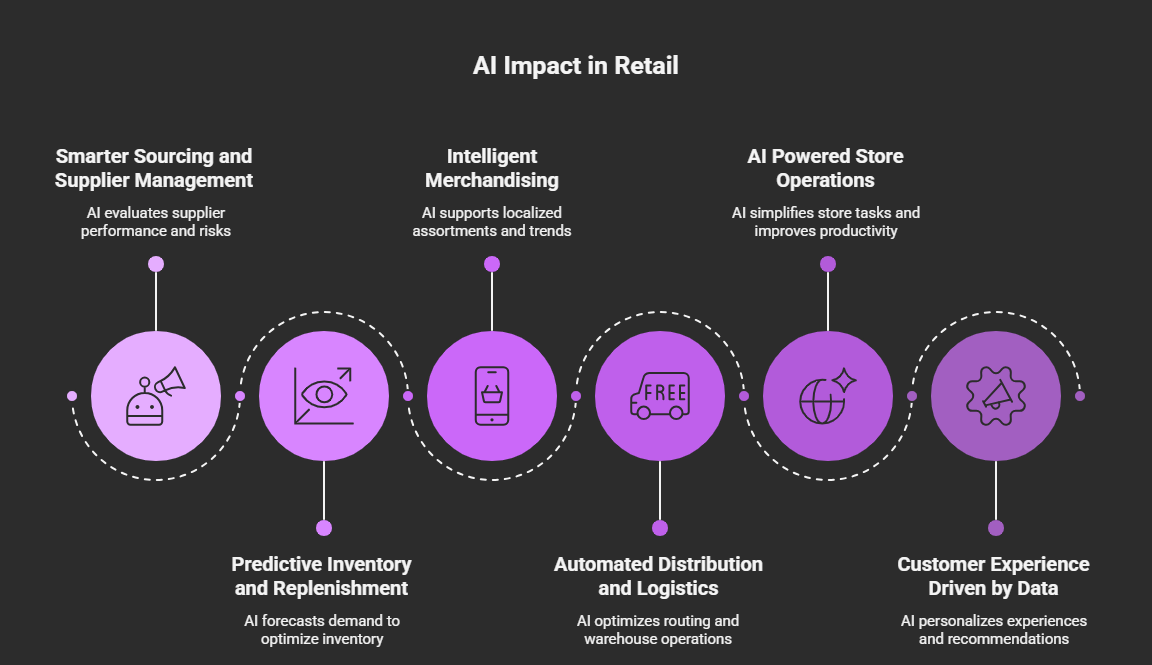
Smarter Sourcing and Supplier Management

AI evaluates supplier performance, lead times, compliance risks and cost fluctuations. Retailers can anticipate disruptions earlier and collaborate more effectively across global networks.

Predictive Inventory and Replenishment

Machine learning models forecast demand at SKU, store and region level. This helps retailers minimise out of stocks, reduce markdowns and improve availability across channels.

Intelligent Merchandising

AI supports teams in:

  • Creating localised assortments.
  • Identifying emerging trends.
  • Testing pricing and promotions.
  • Planning more profitable seasons.

Retailers are shifting from quarterly planning cycles to continuous, data-led optimisation.

Automated Distribution and Logistics

Retailers use AI to optimise routing, warehouse operations, middle mile efficiency and last mile delivery. Robotics and computer vision are increasing accuracy, speed and fulfilment reliability.

AI Powered Store Operations

AI simplifies store tasks through tools such as computer vision shelf monitoring, automated workforce planning and real-time decision guidance for store managers. This improves productivity and operational clarity.

Customer Experience Driven by Data

Unified data platforms bring together online behaviour, in-store interactions, loyalty signals and purchase trends. This enables personalised experiences, relevant recommendations and seamless journeys across all touchpoints.

The Technology Powering the Modern Retail Value Chain

Retailers that are rebuilding their value chains are investing in strong data and technology foundations that include:

  • Cloud platforms for real-time processing.
  • AI and machine learning models for forecasting and automation.
  • Customer data platforms that unify shopper journeys.
  • Digital twins for supply chain visibility.
  • Agentic AI tools that support multi-step retail processes.

These systems allow retailers to operate with greater transparency, accuracy and speed.

Challenges Retailers Must Address

Despite significant opportunities, retailers face important challenges such as:

  • Fragmented data across legacy systems.
  • Limited visibility across global supply chains.
  • Skills gaps in AI, analytics and digital operations.
  • Rising expectations for sustainability and ethical sourcing.
  • The need for responsible and explainable AI.

Forward-looking organisations are strengthening data governance, modernising infrastructure and building cross-functional transformation programs to overcome these barriers.

Preparing for the Next Stage of the Retail Value Chain

Retailers that lead the shift are focusing on:

  • Building unified data platforms across the organisation.
  • Embedding AI into everyday decisions.
  • Increasing automation in supply chain, merchandising and store operations.
  • Strengthening collaboration between digital, commercial and operations teams.
  • Designing value chains that are efficient, profitable and centred on customer needs.

As AI capabilities mature, retailers will move toward fully autonomous value chains that learn, adapt and optimise in real time.

Rebuilding Retail for 2026 and the Years Ahead

The future belongs to retailers that can integrate AI, data and human expertise across their entire value chain. These innovations will create faster operations, stronger decision-making and more personalised customer experiences.

At the NexGen Retail and E-Commerce Summit 2026, leaders from Amazon, Tesco, M and S, Boots, ASDA, The Very Group and global innovators will share how they are rebuilding their value chains and what the next decade of AI powered retail will look like.

Join us in London on April 15 and 16, 2026, and be part of the community shaping the future of retail.

Categories
Retail

Why the E-commerce Innovation Summit Is Shaping the Future of Retail in the UK?

E-commerce Innovation Summit

Why the E-commerce Innovation Summit Is Shaping the Future of Retail in the UK

There is an ongoing change in the UK retail industry. The customer expectations have shifted, digitalization has sped up, and companies, irrespective of their size, have adopted the latest technologies. Brands need to do something extraordinary to be relevant and competitive. In this scenario, the e-commerce innovation summit can be an excellent platform to understand where the sector (retail) is heading and how businesses need to prepare themselves. 

Thought leaders from sectors such as digital commerce, tech, and consumer experience are a critical aspect of the summit. It serves as a strategic center point for navigating disruptions. As the discussions have focused on AI in Retail and E-commerce and insights drawn from events like the Future of Retail Conference, UK retailers now have a clearer blueprint for innovation.

What Makes the E-commerce Innovation Summit a Landmark Event?

This Innovation Summit has evolved into one of the most influential gatherings for brands and digital leaders across the UK. Its significance lies in its ability to bring together a wide spectrum of expertise, including retail strategists, D2C founders, supply chain innovators, and global technology partners. This diversity fuels rich conversations around emerging challenges and breakthrough solutions.

A major reason the summit stands out is its strong focus on upcoming trends showcased at leading events such as the Future of Retail Conference, helping attendees identify which innovations will shape the next phase of retail. With themes centred around AI in Retail and E-commerce, automation, unified commerce, and predictive analytics, the summit allows retailers to understand the technologies that will have the biggest commercial impact. It also offers practical frameworks, case studies, and actionable guidance, enabling senior leaders to convert ideas into on-ground transformation strategies. For UK retailers seeking direction amid evolving consumer behaviour, few platforms offer the depth and clarity that this summit provides.

Technology Trends Redefining the UK Retail Landscape

AI in Retail and E-commerce

The rise of AI in Retail and E-commerce continues to dominate discussions at the E-commerce Innovation Summit as brands accelerate their shift towards data-driven decision-making. Today, AI is powering every major retail function from personalisation engines to automated product recommendations, fraud detection, and real-time inventory optimisation. Predictive analytics helps businesses anticipate demand fluctuations, while AI-driven merchandising ensures customers see the most relevant products at exactly the right time. The momentum seen at the Future of Retail Conference reinforces that AI will remain at the heart of retail transformation.

Omnichannel and Customer Experience Innovations

One of the strongest themes connecting the Future of Retail Conference and the summit is the push towards seamless omnichannel experiences. UK consumers now expect consistent journeys across online stores, apps, physical outlets, and social commerce channels. Retailers are turning to AI in Retail and E-commerce to unify customer data, personalise engagement, and streamline checkout flows. Innovations such as invisible payments, one-click checkout, and automated customer support are enhancing speed and convenience. These shifts reflect a broader movement towards experience-led commerce, where technology augments human service to deliver superior outcomes.

Supply Chain and Fulfilment Advancements

Retail supply chains in the UK are undergoing major restructuring as businesses strive for speed, resilience, and efficiency. The E-commerce Innovation Summit highlights advancements in robotics, automated warehouses, and AI-powered demand forecasting. Technologies showcased at the Future of Retail Conference, such as smart inventory systems, last-mile optimisation tools, and same-day delivery models, are redefining fulfilment expectations. As competition intensifies, retailers who harness these tools will be better equipped to reduce costs, improve delivery timelines, and meet the rising demand for convenience.

What UK Retailers Can Learn from the Summit

The learnings emerging from the E-commerce Innovation Summit extend far beyond trend analysis. UK retailers gain access to real-world insights, practical frameworks, and proven strategies that accelerate innovation. Senior leaders can benchmark their digital maturity, evaluate the adaptability of their supply chain models, and identify gaps in customer experience delivery. Many lessons draw inspiration from the Future of Retail Conference, where global case studies highlight how top-performing brands use AI in Retail and E-commerce to achieve measurable results. For emerging retailers and established enterprises alike, the summit acts as a catalyst for rethinking business models and redesigning operational priorities.

Why Events Like the E-commerce Innovation Summit Are Critical for 2025 and Beyond

Economic shifts, global competition, and significant advancements in digital technology will define the next phase of UK retail. Events such as the E-commerce Innovation Summit and the Future of Retail Conference help businesses anticipate these changes with clarity. Consumer behaviour is evolving rapidly, with higher expectations for hyper-personalised experiences, faster delivery, and frictionless purchasing journeys. Meanwhile, AI in Retail and E-commerce is reshaping everything from pricing strategies to supply chain management, making technological adoption no longer optional but essential.

Retailers also face rising sustainability pressures and regulatory demands, requiring transparent operations and responsible innovation. In this environment, industry events provide a crucial space for analysis, collaboration, and forward planning. UK brands that leverage the insights gained here will be better positioned to navigate uncertainty and secure long-term growth.

Summing Up

The UK retail ecosystem is undergoing a profound reinvention, and the E-commerce Innovation Summit stands at the centre of this transformation. By spotlighting the most pressing challenges and the most promising technologies, the summit acts as a guiding force for businesses preparing for the future. With its continued emphasis on AI in Retail and E-commerce, cross-industry collaboration, and insights aligned with major platforms like the Future of Retail Conference, the summit is shaping the roadmap for the next decade of retail. For brands committed to innovation and sustainable growth, participating in such platforms is no longer optional but essential.

FAQ's

What is the purpose of the E-commerce Innovation Summit?
It provides retailers, technology leaders, and decision-makers with a platform to explore emerging trends, strategic insights, and innovations transforming digital commerce across the UK.
AI helps improve personalisation, optimise supply chains, forecast demand, enhance customer journeys, and reduce operational inefficiencies, making it a core driver of next-generation retail.
Industry veterans, retail strategists, technology partners, founders, CX leaders, and innovators participate to learn about upcoming global retail trends and digital transformation strategies.
By offering access to expert insights, global case studies, and the latest applications of AI in Retail and E-commerce, the summit equips brands to modernise operations and elevate customer experience.
Categories
Banking

Retail Media Networks: How AI Is Powering a 100 Billion Dollar Ad Opportunity

Retail Media Networks: How AI Is Powering a 100 Billion Dollar Ad Opportunity

Retail media is becoming one of the most powerful growth engines in digital advertising. As shoppers move across websites, apps, and physical stores, they generate valuable first party data that is transforming how brands reach consumers.

According to industry reports, retail media has already contributed more than 100 billion dollars in global ad revenue, driven by high intent audiences and measurable sales outcomes. In the United Kingdom, the category has grown rapidly as retailers expand their media networks and invest in AI powered targeting and measurement.

Now, leading retailers are using AI, machine learning, and real time insights to deliver smarter, more relevant ad experiences. These developments will take center stage at the NexGen Retail and E Commerce Summit 2026 in London, where industry leaders will explore how AI is shaping the future of retail media.

The New Era of Retail Media

For years, advertising spend focused on search and social. But the next wave belongs to retailers who own customer data and purchase behavior. AI powered retail media enables brands to:

  • Reach high intent shoppers at the moment of decision
  • Personalize ads with greater relevance
  • Link campaigns directly to verified sales
  • Improve efficiency with real time optimization

This is advertising that learns continuously. Retailers who master this shift are creating entirely new revenue streams while giving brands clearer performance than traditional digital channels.

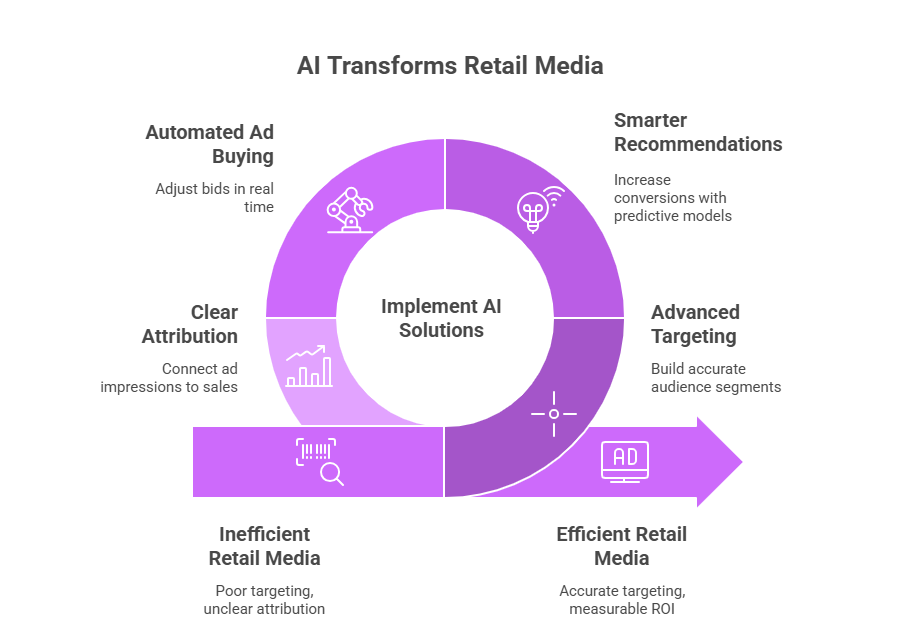
How AI Is Transforming Retail Media

Here is where AI is already driving meaningful impact:

Advanced Targeting

AI analyzes purchase history, browsing behavior, loyalty data, and category patterns to build accurate audience segments that help brands reach the right shopper.

Smarter Recommendations

Sponsored placements and product suggestions are now powered by predictive models that understand intent and increase conversions.

Automated Ad Buying

AI adjusts bids, placements, and budgets in real time based on shopper activity, competition, and predicted outcomes.

Clear Attribution

AI connects every ad impression to actual sales, giving marketers SKU level visibility and measurable ROI. 

At the NexGen Retail and E Commerce Summit 2026, leaders will share practical cases of how AI is improving retail media performance across channels and categories.

The Technology Behind Modern Retail Media

AI driven retail media is built on a connected data ecosystem that includes:

  • Cloud platforms handling large scale shopper data
  • Customer data platforms that unify online and store journeys
  • Machine learning models predicting intent and optimizing campaigns
  • Transparent AI systems that support responsible and trusted advertising

These technologies create intelligent media environments that refine themselves with every interaction and every purchase.

Challenges Retailers Must Navigate

Retail media presents significant opportunity, but there are challenges to solve:

  • Data fragmentation across retail systems
  • Creative fatigue in sponsored placements
  • Increasing privacy requirements
  • Limited AI maturity within marketing teams

Forward looking retailers are addressing these issues with stronger data governance, clear AI ethics, and closer partnerships with brands. These topics will be central discussions in London this April.

Preparing for the Future of Retail Media

Retailers leading the shift are focusing on:

  • Strengthening their first party data infrastructure
  • Investing in AI driven media platforms
  • Expanding ad inventory across digital and physical environments
  • Collaborating with brands to drive measurable outcomes

For teams building their 2026 retail media strategy, the NexGen Retail and E Commerce Summit is the place to learn from the companies setting the pace.

Retail media is rapidly becoming one of the most influential forces in modern retail, and AI is accelerating that shift faster than ever. As targeting, measurement, and personalization evolve, retailers and brands have a unique opportunity to unlock new revenue and reimagine how advertising works across every channel. The NexGen Retail and E Commerce Summit 2026 will bring these conversations to the forefront, with leaders from Amazon, Tesco, M&S, Boots, Asda, and global innovators sharing how AI powered retail media networks are shaping the next era of growth. Join us in London on April 15 to 16 and be part of the community defining the future of retail media.

Categories
Banking

This Is How Agentic Al Is Powering the Next Wave of Retail Growth

This Is How Agentic Al Is Powering the Next Wave of Retail Growth

Agentic AI in retail is redefining automation through self-learning intelligence that transforms retail operations and customer experience.

The New Frontier of Retail Intelligence

Retail has evolved from barcode scanners to self-checkouts, predictive analytics, and warehouse robotics. But a bigger shift is underway: from automation to Agentic AI in retail.

Unlike traditional systems that follow commands, Agentic AI learns, plans, and acts autonomously to achieve business goals. It does not just react; it decides. This next leap will dominate conversations at the NexGen Retail Summit 2026, where global leaders will explore how self-learning AI is reshaping commerce.

Where Retail Automation Stands Today

Retail automation has already transformed efficiency through robotic fulfillment, automated inventory tracking, and chatbots handling customer queries.

According to McKinsey, 78% of companies now use AI in at least one business function, proving automation’s mainstream presence. However, automation alone is reactive; it performs tasks efficiently without real initiative or reasoning. The industry’s next challenge is to make machines that not only follow orders but think ahead.

What Makes Agentic AI Different

Agentic AI in retail takes automation to the next level. These AI agents can sense their environment, reason independently, and act without human direction. As IBM defines it, agentic systems go beyond generative AI by integrating goal-oriented behavior and continuous learning.

For example, instead of alerting a manager to low stock, an agentic system can automatically restock items, adjust supplier contracts, and update online listings in real time. Google Cloud highlights this evolution as the foundation for intelligent retail ecosystems that combine analytics, large language models, and IoT data to drive real-world actions.

Where Agentic AI Is Already Making an Impact

  1. Autonomous Supply Chains: Agents detect disruptions, reroute shipments, and reorder inventory automatically. Early adopters such as Walmart report faster restock times and fewer outages.
  2. Real-Time Pricing Optimization: Agentic systems continuously adjust prices based on demand, stock, and competitor moves to improve both margin and customer value.
  3. Intelligent Store Operations: Agents analyze foot traffic, energy usage, and staff schedules to optimize store performance and resource allocation.
  4. Personalized Customer Engagement: Virtual advisors act like digital store managers, understanding preferences and intent to offer curated recommendations instantly.

These use cases demonstrate how Agentic AI supports AI-powered retail innovation and intelligent retail operations.

Enablers and Ethical Challenges

To make Agentic AI work at scale, retailers need:

  • Unified data ecosystems connecting inventory, sales, and customer insights.
  • Edge AI and IoT integration for real-time decision-making.
  • Governance frameworks that ensure ethical and explainable AI

However, risks remain. Gartner predicts that 40% of agentic AI projects may be scrapped by 2027 because of unclear ROI and governance issues. Building trust, ensuring data privacy, and integrating new AI tools with legacy systems are critical next steps.

Preparing for the Leap

Retailers can begin their Agentic AI journey by:

  1. Assessing readiness: Evaluate automation maturity and data quality.
  2. Starting small: Pilot agentic use cases in pricing or supply chain management.
  3. Building governance: Maintain human oversight and transparency.
  4. Upskilling teams: Train employees to work alongside AI-driven systems.
  5. Collaborating widely: Partner with technology vendors and ecosystem players to scale innovation safely.

The move from automation to Agentic AI in retail marks a defining moment for the industry. It introduces intelligent systems that learn, adapt, and make decisions that enhance both efficiency and customer value.

At TechTrek Events, we organize forums and discussions that bring together industry professionals to explore the latest trends and innovations. 

The NexGen Retail Summit provides a platform for these conversations, where leaders and innovators share insights and ideas on how AI and emerging technologies are driving the next wave of growth in retail.